| MOQ: | 1000PCS |
| Price: | Negotiable |
| Standard Packaging: | Carton ,bubble Bag , Plastic Box |
| Delivery Period: | 15-30 Days |
| Payment Method: | T/T |
| Supply Capacity: | Small Orders Accepted |
Precision-Engineered | Corrosion-Resistant | Adjustable Design | OEM & ODM Customization
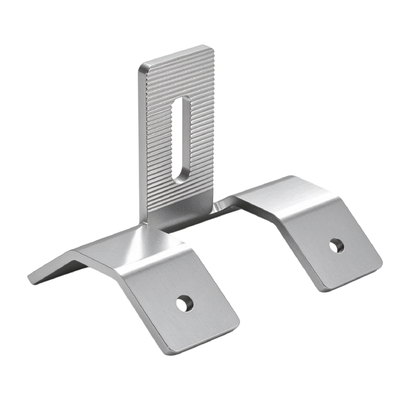
Our Adjustable Roof Clamps for Trapezoidal Metal Roofs provide a secure and flexible mounting solution for commercial, industrial, and rooftop solar PV systems.
Featuring an adjustable design, these clamps can be customized to fit different roof profiles and solar rail connections, ensuring efficient installation and reliable performance.
Manufactured with durable, corrosion-resistant materials, they are available with optional EPDM seals, stainless steel fasteners, and customized mounting configurations for various project requirements.
We offer flexible OEM/ODM manufacturing solutions for solar mounting system manufacturers, distributors, and project contractors.
Need custom roof clamps? Send us your drawings or samples for a tailored solution and quotation.
![]()
The adjustable structure can be designed to accommodate variations in trapezoidal rib width, height, angle, and mounting position. Depending on the selected configuration, slotted connections and adjustable brackets allow installers to fine-tune the mounting position during assembly.
Available material options include SUS304 stainless steel and aluminum alloys, subject to the selected product design. Material selection is based on mechanical requirements, corrosion exposure, fastening conditions, and compatibility with the solar mounting system.
Appropriate material grades and surface treatments help protect metal components against environmental exposure. Stainless steel fasteners and compatible surface finishes can be selected according to project conditions.
EPDM rubber pads, gaskets, or sealing washers can be incorporated where required by the design. Their configuration must match the roof profile and fastening method to help reduce water ingress and protect the roof interface.
The upper connection can be tailored to suit different rail mounting arrangements, including slotted plates, L-foot brackets, T-bolt connections, and other project-specific interfaces.
We support customized dimensions, material thicknesses, hole positions, slot geometries, surface treatments, fastener configurations, and packaging requirements based on approved drawings or physical samples.
The following table presents typical design options for this product category. Final specifications depend on the approved drawing and project requirements.
| Parameter | Specification / Available Options |
|---|---|
| Product Name | Adjustable Trapezoidal Metal Roof Clamp |
| Application | Solar PV mounting systems for trapezoidal metal roofs |
| Product Type | Adjustable roof clamp / solar mounting bracket |
| Main Materials | SUS304 stainless steel, aluminum alloy, or specified alternatives |
| Material Thickness | Customized according to design and load requirements |
| Adjustment | Height, width, or mounting position, depending on configuration |
| Roof Compatibility | Trapezoidal and selected ribbed metal roof profiles |
| Rail Connection | L-foot, T-bolt, slotted plate, or customized interface |
| Fasteners | Stainless steel or specified compatible hardware |
| Sealing Components | Optional EPDM pads, gaskets, or bonded sealing washers |
| Surface Treatment | Natural finish, passivation, anodizing for compatible aluminum parts, or other specified finishes |
| Manufacturing Processes | Cutting, punching, bending, stamping, machining, assembly, as applicable |
| Customization | OEM / ODM available |
| Inspection | Dimensional, visual, and specified functional checks |
| Packaging | Bulk cartons, individual packaging, or customized export packaging |
Engineering note: Load capacity, wind uplift resistance, allowable adjustment range, and roof compatibility must be verified for the specific clamp design and installation method. Product performance depends on the roof sheet, supporting structure, fasteners, spacing, and local design conditions.
Our adjustable roof clamps can be developed for a range of photovoltaic mounting applications, including:
Commercial and industrial rooftop solar installations.
Factory and warehouse metal roof PV systems.
Distributed solar power generation projects.
Solar mounting rail and bracket assemblies.
Solar mounting system OEM production.
Customized photovoltaic mounting hardware.
Replacement components and retrofit solar projects.
For new projects, we recommend providing the trapezoidal roof cross-section, sheet thickness, purlin arrangement, and mounting rail specifications. These details help determine whether a standard configuration is suitable or a custom clamp design is required.
A dependable roof clamp requires more than a suitable material. Dimensional accuracy, forming consistency, fastening alignment, corrosion resistance, and compatibility with the complete mounting assembly all contribute to product performance.
Our manufacturing approach can be tailored to your drawings, required tolerances, production volumes, and quality expectations.
Drawing review and manufacturability assessment.
Dimensional and tolerance review.
Material and thickness recommendations.
Hole, slot, and bending geometry optimization.
Prototype development and sample evaluation.
Design adjustments based on assembly feedback.
For custom parts, early engineering review helps identify potential manufacturing issues before mass production, reducing unnecessary tooling changes and improving production efficiency.
Depending on the approved design and available production route, manufacturing processes may include:
Precision sheet metal cutting.
Punching and hole forming.
CNC bending and forming.
Metal stamping and press forming.
Machining of specified features.
Deburring and edge finishing.
Fastener installation and component assembly.
For stable, high-volume production, suitable tooling and controlled forming processes can help maintain repeatability across production batches.
Quality requirements are established according to the product drawing, material specification, and customer inspection plan.
| Quality Control Stage | Inspection Focus |
|---|---|
| Incoming Material | Material grade, thickness, surface condition, and documentation where specified |
| First-Article Inspection | Critical dimensions, hole positions, slot dimensions, and forming geometry |
| In-Process Inspection | Dimensional consistency, forming quality, and visible defects |
| Assembly Inspection | Fastener fit, interface alignment, and component completeness |
| Final Inspection | Appearance, quantity, packaging, and agreed inspection criteria |
| Documentation | Inspection records, material certificates, or other documents as contractually required |
We can evaluate suitable production methods based on annual demand, design complexity, and delivery targets.
Prototype orders: For fit checks, installation trials, and initial design validation.
Small-batch production: For pilot projects, product development, and customized orders.
Volume production: For repeat orders requiring consistent dimensions and controlled manufacturing processes.
Actual tooling requirements, minimum order quantities, lead times, and inspection arrangements are confirmed during quotation.
Every solar mounting project has its own requirements for roof geometry, rail interface, environmental exposure, and installation efficiency. A standard component may not always provide the best fit.
A custom manufacturing approach helps bridge the gap between product design and practical installation.
Design-to-manufacturing coordination
We review drawings and component requirements before production to help identify dimensional conflicts, difficult forming features, and potential assembly issues.
Flexible material and configuration options
Material grade, thickness, connection details, and sealing components can be evaluated according to the intended application.
Repeatable production
Clearly defined drawings, approved samples, and agreed inspection criteria establish a consistent reference for repeat orders.
Project-oriented communication
Technical requirements, sample feedback, production specifications, and packaging details can be coordinated throughout the manufacturing process.
OEM and private-label support
Customized part identification, packaging, and labeling can be discussed for distributors and solar mounting system brands.
Our objective is to help customers obtain roof clamp components that meet their design intent, installation requirements, and procurement expectations.
The following examples illustrate common project scenarios for this product category. They are representative application templates, not claims of completed customer projects. Replace them with verified customer information before publication.
Project requirement: A solar installation contractor needed adjustable mounting clamps for a trapezoidal metal roof with specific rib dimensions and rail positioning requirements.
Manufacturing approach:
Reviewed roof profile drawings and mounting interface dimensions.
Evaluated clamp geometry and adjustment requirements.
Customized hole positions and connection details.
Prepared samples for fit and assembly verification.
Project objective: Improve installation compatibility and reduce on-site adjustments through a design matched to the roof and mounting rail.
Project requirement: A mounting system manufacturer required a repeatable supply of metal roof clamps for integration into its proprietary solar rail assemblies.
Manufacturing approach:
Confirmed approved drawings and material specifications.
Established critical dimensional inspection points.
Coordinated production and packaging requirements.
Used agreed inspection criteria to support repeat-order consistency.
Project objective: Establish a stable component supply process for ongoing solar mounting system production.
Project requirement: A solar hardware distributor wanted customized clamp configurations for different customer mounting systems.
Manufacturing approach:
Reviewed multiple clamp configurations and rail interfaces.
Evaluated material and surface treatment options.
Developed samples for product selection and customer evaluation.
Coordinated customized labeling and packaging requirements.
Project objective: Support a differentiated product offering with flexible specifications and OEM manufacturing options.
For a stronger website case-study section, add actual project photographs, customer-approved industry information, verified order quantities, and measurable production outcomes.
A structured workflow helps keep engineering, production, and quality requirements aligned.
Step 1 — Requirement Review
Share your 2D drawings, 3D models, roof profile dimensions, sample parts, or preliminary specifications.
Step 2 — Engineering Evaluation
We review material requirements, critical dimensions, manufacturing feasibility, and the proposed mounting interface.
Step 3 — Quotation & Production Planning
Confirm the selected design, quantity, tooling requirements, surface treatment, inspection criteria, and delivery arrangements.
Step 4 — Sample Development
Produce prototype or first-article samples where required for dimensional inspection and assembly verification.
Step 5 — Production & Quality Inspection
Manufacture according to the approved specifications and agreed quality control plan.
Step 6 — Packaging & Delivery
Pack and identify the products according to the confirmed order requirements, then arrange shipment according to the agreed commercial terms.
In a solar mounting system, roof clamps form part of the load-transfer path between the roof structure and the PV mounting assembly. Incorrect dimensions, unsuitable fasteners, poor interface matching, or inadequate sealing can compromise installation quality.
For this reason, our product development approach emphasizes three essential considerations:
1. Dimensional compatibility
The clamp geometry, hole locations, adjustment range, and rail interface must correspond to the actual installation requirements.
2. Material and environmental suitability
The material grade and finish should be selected according to corrosion exposure, mechanical requirements, and compatibility with adjacent components.
3. Verified installation performance
The complete mounting arrangement must be evaluated against applicable structural design requirements, including wind uplift, snow loads where relevant, fastener capacity, and roof-sheet limitations.
We work with customers to translate these requirements into clear manufacturing specifications, helping create components that are practical to produce, inspect, assemble, and reorder.
Important: Roof clamp selection and installation should follow the approved mounting system design and applicable local building requirements. Adjustable geometry alone does not establish structural capacity or universal roof compatibility.
They are designed for trapezoidal metal roof profiles and selected ribbed roofing configurations. Compatibility depends on the rib width, height, angle, roof sheet construction, and fastening arrangement. Please provide the roof profile drawing or dimensions for evaluation.
Yes. Depending on manufacturing feasibility, we can customize the base dimensions, bracket height, adjustment slots, hole positions, material thickness, and rail connection interface according to approved drawings or samples.
Common options include SUS304 stainless steel and aluminum alloys. The appropriate material depends on the product design, mechanical requirements, environmental conditions, and the properties of the connected components.
EPDM pads, gaskets, or sealing washers can be included where required by the design. Their suitability depends on the roof profile, fastening method, and specified sealing arrangement.
Yes, subject to interface compatibility. Options may include L-foot brackets, T-bolt connections, slotted plates, and customized rail interfaces. Please provide the rail cross-section or connection drawing to confirm compatibility.
| MOQ: | 1000PCS |
| Price: | Negotiable |
| Standard Packaging: | Carton ,bubble Bag , Plastic Box |
| Delivery Period: | 15-30 Days |
| Payment Method: | T/T |
| Supply Capacity: | Small Orders Accepted |
Precision-Engineered | Corrosion-Resistant | Adjustable Design | OEM & ODM Customization
Our Adjustable Roof Clamps for Trapezoidal Metal Roofs provide a secure and flexible mounting solution for commercial, industrial, and rooftop solar PV systems.
Featuring an adjustable design, these clamps can be customized to fit different roof profiles and solar rail connections, ensuring efficient installation and reliable performance.
Manufactured with durable, corrosion-resistant materials, they are available with optional EPDM seals, stainless steel fasteners, and customized mounting configurations for various project requirements.
We offer flexible OEM/ODM manufacturing solutions for solar mounting system manufacturers, distributors, and project contractors.
Need custom roof clamps? Send us your drawings or samples for a tailored solution and quotation.
![]()
The adjustable structure can be designed to accommodate variations in trapezoidal rib width, height, angle, and mounting position. Depending on the selected configuration, slotted connections and adjustable brackets allow installers to fine-tune the mounting position during assembly.
Available material options include SUS304 stainless steel and aluminum alloys, subject to the selected product design. Material selection is based on mechanical requirements, corrosion exposure, fastening conditions, and compatibility with the solar mounting system.
Appropriate material grades and surface treatments help protect metal components against environmental exposure. Stainless steel fasteners and compatible surface finishes can be selected according to project conditions.
EPDM rubber pads, gaskets, or sealing washers can be incorporated where required by the design. Their configuration must match the roof profile and fastening method to help reduce water ingress and protect the roof interface.
The upper connection can be tailored to suit different rail mounting arrangements, including slotted plates, L-foot brackets, T-bolt connections, and other project-specific interfaces.
We support customized dimensions, material thicknesses, hole positions, slot geometries, surface treatments, fastener configurations, and packaging requirements based on approved drawings or physical samples.
The following table presents typical design options for this product category. Final specifications depend on the approved drawing and project requirements.
| Parameter | Specification / Available Options |
|---|---|
| Product Name | Adjustable Trapezoidal Metal Roof Clamp |
| Application | Solar PV mounting systems for trapezoidal metal roofs |
| Product Type | Adjustable roof clamp / solar mounting bracket |
| Main Materials | SUS304 stainless steel, aluminum alloy, or specified alternatives |
| Material Thickness | Customized according to design and load requirements |
| Adjustment | Height, width, or mounting position, depending on configuration |
| Roof Compatibility | Trapezoidal and selected ribbed metal roof profiles |
| Rail Connection | L-foot, T-bolt, slotted plate, or customized interface |
| Fasteners | Stainless steel or specified compatible hardware |
| Sealing Components | Optional EPDM pads, gaskets, or bonded sealing washers |
| Surface Treatment | Natural finish, passivation, anodizing for compatible aluminum parts, or other specified finishes |
| Manufacturing Processes | Cutting, punching, bending, stamping, machining, assembly, as applicable |
| Customization | OEM / ODM available |
| Inspection | Dimensional, visual, and specified functional checks |
| Packaging | Bulk cartons, individual packaging, or customized export packaging |
Engineering note: Load capacity, wind uplift resistance, allowable adjustment range, and roof compatibility must be verified for the specific clamp design and installation method. Product performance depends on the roof sheet, supporting structure, fasteners, spacing, and local design conditions.
Our adjustable roof clamps can be developed for a range of photovoltaic mounting applications, including:
Commercial and industrial rooftop solar installations.
Factory and warehouse metal roof PV systems.
Distributed solar power generation projects.
Solar mounting rail and bracket assemblies.
Solar mounting system OEM production.
Customized photovoltaic mounting hardware.
Replacement components and retrofit solar projects.
For new projects, we recommend providing the trapezoidal roof cross-section, sheet thickness, purlin arrangement, and mounting rail specifications. These details help determine whether a standard configuration is suitable or a custom clamp design is required.
A dependable roof clamp requires more than a suitable material. Dimensional accuracy, forming consistency, fastening alignment, corrosion resistance, and compatibility with the complete mounting assembly all contribute to product performance.
Our manufacturing approach can be tailored to your drawings, required tolerances, production volumes, and quality expectations.
Drawing review and manufacturability assessment.
Dimensional and tolerance review.
Material and thickness recommendations.
Hole, slot, and bending geometry optimization.
Prototype development and sample evaluation.
Design adjustments based on assembly feedback.
For custom parts, early engineering review helps identify potential manufacturing issues before mass production, reducing unnecessary tooling changes and improving production efficiency.
Depending on the approved design and available production route, manufacturing processes may include:
Precision sheet metal cutting.
Punching and hole forming.
CNC bending and forming.
Metal stamping and press forming.
Machining of specified features.
Deburring and edge finishing.
Fastener installation and component assembly.
For stable, high-volume production, suitable tooling and controlled forming processes can help maintain repeatability across production batches.
Quality requirements are established according to the product drawing, material specification, and customer inspection plan.
| Quality Control Stage | Inspection Focus |
|---|---|
| Incoming Material | Material grade, thickness, surface condition, and documentation where specified |
| First-Article Inspection | Critical dimensions, hole positions, slot dimensions, and forming geometry |
| In-Process Inspection | Dimensional consistency, forming quality, and visible defects |
| Assembly Inspection | Fastener fit, interface alignment, and component completeness |
| Final Inspection | Appearance, quantity, packaging, and agreed inspection criteria |
| Documentation | Inspection records, material certificates, or other documents as contractually required |
We can evaluate suitable production methods based on annual demand, design complexity, and delivery targets.
Prototype orders: For fit checks, installation trials, and initial design validation.
Small-batch production: For pilot projects, product development, and customized orders.
Volume production: For repeat orders requiring consistent dimensions and controlled manufacturing processes.
Actual tooling requirements, minimum order quantities, lead times, and inspection arrangements are confirmed during quotation.
Every solar mounting project has its own requirements for roof geometry, rail interface, environmental exposure, and installation efficiency. A standard component may not always provide the best fit.
A custom manufacturing approach helps bridge the gap between product design and practical installation.
Design-to-manufacturing coordination
We review drawings and component requirements before production to help identify dimensional conflicts, difficult forming features, and potential assembly issues.
Flexible material and configuration options
Material grade, thickness, connection details, and sealing components can be evaluated according to the intended application.
Repeatable production
Clearly defined drawings, approved samples, and agreed inspection criteria establish a consistent reference for repeat orders.
Project-oriented communication
Technical requirements, sample feedback, production specifications, and packaging details can be coordinated throughout the manufacturing process.
OEM and private-label support
Customized part identification, packaging, and labeling can be discussed for distributors and solar mounting system brands.
Our objective is to help customers obtain roof clamp components that meet their design intent, installation requirements, and procurement expectations.
The following examples illustrate common project scenarios for this product category. They are representative application templates, not claims of completed customer projects. Replace them with verified customer information before publication.
Project requirement: A solar installation contractor needed adjustable mounting clamps for a trapezoidal metal roof with specific rib dimensions and rail positioning requirements.
Manufacturing approach:
Reviewed roof profile drawings and mounting interface dimensions.
Evaluated clamp geometry and adjustment requirements.
Customized hole positions and connection details.
Prepared samples for fit and assembly verification.
Project objective: Improve installation compatibility and reduce on-site adjustments through a design matched to the roof and mounting rail.
Project requirement: A mounting system manufacturer required a repeatable supply of metal roof clamps for integration into its proprietary solar rail assemblies.
Manufacturing approach:
Confirmed approved drawings and material specifications.
Established critical dimensional inspection points.
Coordinated production and packaging requirements.
Used agreed inspection criteria to support repeat-order consistency.
Project objective: Establish a stable component supply process for ongoing solar mounting system production.
Project requirement: A solar hardware distributor wanted customized clamp configurations for different customer mounting systems.
Manufacturing approach:
Reviewed multiple clamp configurations and rail interfaces.
Evaluated material and surface treatment options.
Developed samples for product selection and customer evaluation.
Coordinated customized labeling and packaging requirements.
Project objective: Support a differentiated product offering with flexible specifications and OEM manufacturing options.
For a stronger website case-study section, add actual project photographs, customer-approved industry information, verified order quantities, and measurable production outcomes.
A structured workflow helps keep engineering, production, and quality requirements aligned.
Step 1 — Requirement Review
Share your 2D drawings, 3D models, roof profile dimensions, sample parts, or preliminary specifications.
Step 2 — Engineering Evaluation
We review material requirements, critical dimensions, manufacturing feasibility, and the proposed mounting interface.
Step 3 — Quotation & Production Planning
Confirm the selected design, quantity, tooling requirements, surface treatment, inspection criteria, and delivery arrangements.
Step 4 — Sample Development
Produce prototype or first-article samples where required for dimensional inspection and assembly verification.
Step 5 — Production & Quality Inspection
Manufacture according to the approved specifications and agreed quality control plan.
Step 6 — Packaging & Delivery
Pack and identify the products according to the confirmed order requirements, then arrange shipment according to the agreed commercial terms.
In a solar mounting system, roof clamps form part of the load-transfer path between the roof structure and the PV mounting assembly. Incorrect dimensions, unsuitable fasteners, poor interface matching, or inadequate sealing can compromise installation quality.
For this reason, our product development approach emphasizes three essential considerations:
1. Dimensional compatibility
The clamp geometry, hole locations, adjustment range, and rail interface must correspond to the actual installation requirements.
2. Material and environmental suitability
The material grade and finish should be selected according to corrosion exposure, mechanical requirements, and compatibility with adjacent components.
3. Verified installation performance
The complete mounting arrangement must be evaluated against applicable structural design requirements, including wind uplift, snow loads where relevant, fastener capacity, and roof-sheet limitations.
We work with customers to translate these requirements into clear manufacturing specifications, helping create components that are practical to produce, inspect, assemble, and reorder.
Important: Roof clamp selection and installation should follow the approved mounting system design and applicable local building requirements. Adjustable geometry alone does not establish structural capacity or universal roof compatibility.
They are designed for trapezoidal metal roof profiles and selected ribbed roofing configurations. Compatibility depends on the rib width, height, angle, roof sheet construction, and fastening arrangement. Please provide the roof profile drawing or dimensions for evaluation.
Yes. Depending on manufacturing feasibility, we can customize the base dimensions, bracket height, adjustment slots, hole positions, material thickness, and rail connection interface according to approved drawings or samples.
Common options include SUS304 stainless steel and aluminum alloys. The appropriate material depends on the product design, mechanical requirements, environmental conditions, and the properties of the connected components.
EPDM pads, gaskets, or sealing washers can be included where required by the design. Their suitability depends on the roof profile, fastening method, and specified sealing arrangement.
Yes, subject to interface compatibility. Options may include L-foot brackets, T-bolt connections, slotted plates, and customized rail interfaces. Please provide the rail cross-section or connection drawing to confirm compatibility.